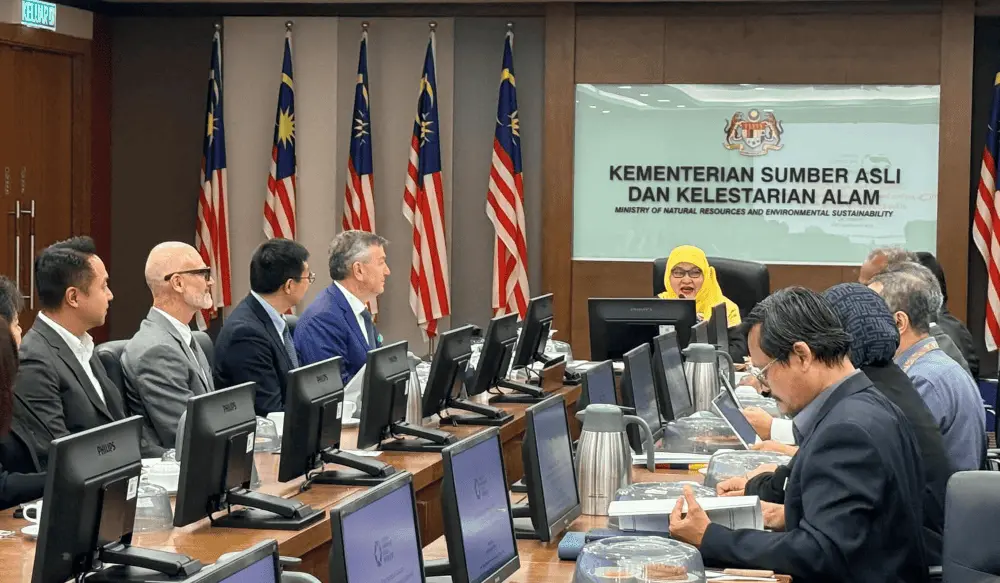
Xeptagon recently took part in Hong Kong's Business Environment Council Green Development Mission to Malaysia, joining a delegation focused on sustainability, green technologies, energy transition, nature and sustainable urban development. The mission brought Hong Kong business leaders into dialogue with Malaysia's government, industry and sustainability ecosystem from 2 to 5 June 2026.
As part of the visit, Xeptagon engaged with key organisations including Ministry of Natural Resources and Environmental Sustainability (NRES), PETRONAS, MIMOS Berhad, Cyberview Sdn Bhd, Malaysian Investment Development Authority and other stakeholders working across Malaysia's carbon market, renewable energy, sustainability and digital transformation landscape.
The visit came at an important time for Malaysia's climate and carbon market development. Malaysia's National Carbon Market Policy, launched by the Ministry of Natural Resources and Environmental Sustainability, sets the foundation for a stronger carbon market ecosystem, including high-integrity carbon credits, Article 6 participation, carbon market governance, MRV systems and future market-based instruments.
For Xeptagon, this direction is highly aligned with the company's work in climate finance and carbon market infrastructure. Xeptagon develops digital infrastructure for climate finance, carbon markets and Article 6 implementation, working with governments, multilaterals and regulated entities across areas such as carbon registries, climate transparency systems, emissions trading infrastructure, MRV systems and carbon market platforms.
One of the key themes emerging from the Malaysia discussions was the importance of moving from climate policy to implementation. Carbon markets, renewable energy systems and climate reporting frameworks require trusted digital infrastructure to operate effectively. This includes systems to track projects, emissions data, credits, renewable energy certificates, transfers, retirements, claims and reporting obligations.

Malaysia's carbon market ecosystem is now entering a critical implementation phase. The National Carbon Registry is reported to be under development and is expected to play an important role in tracking verified carbon projects, supporting transparency, avoiding double counting and enabling future Article 6.2 transfers and domestic carbon market mechanisms.
This reinforces a broader point that is central to Xeptagon's work: carbon markets cannot scale without strong digital public infrastructure. A carbon registry is not simply a database. It is the trust layer that enables governments, project developers, corporates, verifiers, exchanges and international partners to participate in a credible carbon market.
The same principle applies to renewable energy and corporate decarbonisation. As Malaysia accelerates renewable energy adoption and green investment, companies will increasingly require systems to manage renewable energy certificates, emissions reporting, carbon claims, CBAM readiness, climate-related disclosures and supply-chain transparency.
Xeptagon sees strong potential for collaboration in Malaysia across several areas, including national carbon registry infrastructure, Article 6 readiness, MRV systems, carbon market platforms, climate transparency reporting, REC tracking, green claims validation and corporate carbon management.
The opportunity is broader than carbon trading alone. It is about building the digital foundation for a low-carbon economy. For governments, this means stronger transparency, market integrity and implementation capacity. For corporates, it means credible climate reporting, better access to green finance and stronger readiness for emerging carbon and sustainability requirements. For investors, it means higher confidence in the data behind green investments.
Xeptagon's participation in the BEC delegation reflects the company's continued focus on building partnerships across Asia and supporting countries as they move from climate ambition to measurable implementation.
Malaysia is moving quickly on carbon markets, climate reporting, green finance and renewable energy adoption. Xeptagon looks forward to continuing the conversations started during the mission and exploring how its experience in carbon registries, MRV, Article 6 systems and climate reporting can support Malaysia's sustainability journey.