

Digital MRV is more than data collection or visual reporting. It governs how environmental information is captured, calculated, reviewed, verified, approved and transferred into the systems that depend on it.
Xeptagon digitises Measurement, Reporting and Verification (MRV) across carbon markets, climate-finance programmes, environmental assets and enterprise emissions. Our platform brings methodologies, monitoring plans, field and system data, calculations, evidence, validation and independent verification into one governed environment.
Configurable workflows and secure integrations connect verified outcomes with registries, Article 6 systems, climate-finance platforms, Article 13 transparency systems and environmental markets.
The platform is built on Xeptagon’s experience delivering registry, transparency, environmental-finance and data systems for governments, United Nations agencies, multilateral programmes and global enterprises.
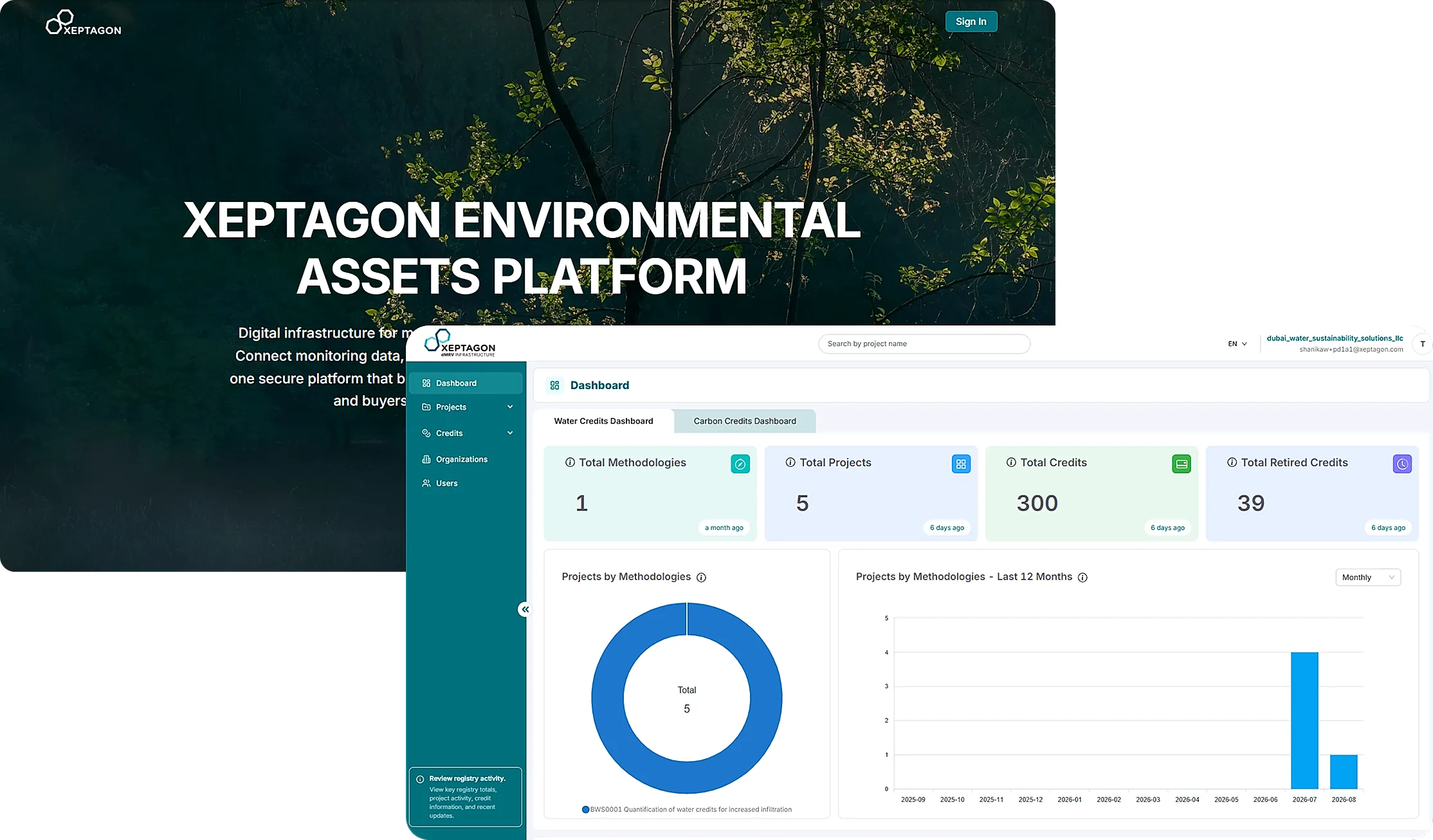
Xeptagon’s Digital Measurement, Reporting and Verification (dMRV) platform manages the complete journey from methodology configuration and project registration to monitoring, data collection, calculation, reporting and independent verification. Each stage is governed through structured workflows, defined stakeholder responsibilities and complete audit trails. Once approved, verified outcomes can flow directly into registries, Article 6 systems, climate-finance programmes, transparency platforms, exchanges or other authorised downstream systems.
Programme administrators define eligibility requirements, parameters, calculations, monitoring rules, evidence requirements and stakeholder responsibilities.
Programme administrators define eligibility requirements, parameters, calculations, monitoring rules, evidence requirements and stakeholder responsibilities.
Project developers, facilities, organisations or programme participants submit the required legal, technical, geographic and environmental information.
The platform records baselines, monitoring indicators, reporting periods, responsible data providers and evidence requirements for the relevant methodology.
Field users, enterprise systems, sensors, external databases and geospatial services provide structured data and supporting evidence through secure interfaces.
The system applies approved formulas, factors and validation rules, identifying incomplete records, anomalies and inconsistencies for review.
Verified datasets, calculations, supporting evidence and explanations are assembled into a structured monitoring report for formal review.
Authorised validators and verifiers review the submission, record findings, request corrections and provide a documented verification decision.
Approved outcomes can be transferred to a registry, Article 6 system, climate-finance programme, transparency platform, exchange or other authorised downstream system.
Environmental programmes differ in methodologies, data requirements, actors and approval processes. Xeptagon’s workflow engine allows institutions to configure each programme without maintaining separate systems or repeatedly redeveloping core functionality.
Design multi-stage processes for onboarding, monitoring, validation, verification, approval and downstream transfer.
Create methodology-specific forms, fields, tables, documents and evidence requirements for different sectors and environmental assets.
Operate different standards, methodologies and programme types within one platform while preserving independent rules and lifecycle requirements.
Assign tasks and decisions to programme administrators, regulators, project developers, data providers, validators, verifiers and technical reviewers.
Introduce new methodology or process versions while preserving historical configurations, decisions and approved outcomes.
Support several jurisdictions, standards or environmental programmes through shared infrastructure with secure data separation and independent governance.
The platform provides secure integration tools for connecting existing data sources rather than requiring institutions to replace every operational system.
Capture observations, measurements, images, documents and geolocation information through web and mobile workflows, including offline environments.
Connect smart meters, monitoring devices, environmental sensors, facility systems and emissions-estimation tools through secure APIs.
Integrate satellite imagery, land boundaries, geospatial layers and remote-sensing outputs for forestry, agriculture, nature and land-use programmes.
Connect environmental management systems, enterprise resource planning tools, supply-chain platforms and operational databases.
Exchange data with national inventories, statistical platforms, sector databases, registry systems and regulatory reporting environments.
Use secure application programming interfaces and event-driven webhooks to synchronise submissions, approvals, verified outcomes and lifecycle changes with external systems.
Xeptagon can integrate artificial intelligence into selected MRV workflows to improve data quality, identify risks and reduce repetitive review work. AI-generated results remain subject to transparent rules, authorised review and human decision-making.
AI does not replace accredited validation, verification or regulatory decisions. It supports authorised professionals by directing attention to potential issues and improving the efficiency of review.
A central workspace for configuring programmes, supervising monitoring activities and maintaining institutional oversight.
A dedicated environment for organisations responsible for environmental activities, facilities or regulated emissions.
A simplified interface for field personnel, facility teams and authorised data providers.
A governed workspace for independent assurance providers and technical reviewers.
Digital MRV provides the measurement and assurance foundation used by registries, markets, reporting systems and finance programmes. Xeptagon connects verified outcomes to the systems responsible for issuance, accounting, payment, trading and national reporting.
Transfer approved environmental outcomes to carbon, energy, water, plastic or biodiversity registries for issuance and lifecycle management.
Connect authorised mitigation outcomes with national registries, Internationally Transferred Mitigation Outcome tracking and corresponding-adjustment processes.
Provide verified sectoral and programme data to national transparency platforms supporting greenhouse-gas inventories, Nationally Determined Contribution tracking and Biennial Transparency Reports.
Use verified outcomes to support results-based finance, Payment for Environmental Services, beneficiary payments and donor reporting.
Connect issued environmental assets with exchanges, marketplaces, settlement systems and approved tokenization infrastructure.
Publish authorised information through regulator dashboards, programme reports, public portals and institutional analytics.
Digitise project methodologies, monitoring reports, emissions calculations, validation and verification for voluntary, compliance and Article 6-related carbon programmes.
Coordinate environmental data across ministries, agencies, sectors, facilities and regulated entities through standardised national workflows.
Link field evidence, performance indicators and verification decisions with climate-finance approvals and payment triggers.
Integrate facility, energy, production and supply-chain information for Scope 1, Scope 2 and selected Scope 3 emissions monitoring.
Monitor forestry, agriculture, biodiversity, water, plastic recovery and ecosystem-service programmes using field, GIS and remote-sensing evidence.
Track the environmental information supporting renewable energy certificates, Guarantees of Origin and Sustainable Aviation Fuel attributes.
Xeptagon’s Digital MRV platform can integrate with Hedera Guardian or other approved public, private or permissioned blockchain environments.
Selected monitoring records, evidence, verification events and approved outcomes can be cryptographically anchored to provide independently verifiable timestamps and data-integrity evidence. The primary MRV platform remains the governed source of truth, preserving regulator and programme-owner control.
Xeptagon’s Digital MRV capabilities are informed by practical experience delivering registry, transparency, environmental-finance and enterprise-data systems across multiple regions.
Connects beneficiary enrolment, field monitoring, evidence, verification and performance-based environmental payments across Central Africa.
Provides the downstream registry infrastructure required to convert approved mitigation outcomes into traceable environmental units.
Connects sectoral climate information with national Article 13 reporting, greenhouse-gas inventories and Biennial Transparency Report preparation.
Demonstrated how enterprise emissions information can connect with environmental-market and exchange infrastructure.
Connected methodology workflows, registry processes and blockchain-backed environmental-asset traceability.
Xeptagon combines environmental-market expertise, data engineering and production software delivery to build systems for governments, United Nations agencies, multilateral programmes and global enterprises.
Xeptagon designed, developed and continues to maintain national carbon registry and climate-transparency infrastructure delivered for the United Nations Development Programme.
Xeptagon operates an ISO 9001:2015-certified Quality Management System and an ISO/IEC 27001:2022-certified Information Security Management System.
Role-based permissions, complete audit trails, controlled change management and secure data handling support institutional oversight.
Platforms can be deployed through managed cloud, sovereign cloud, government-controlled, on-premise or hybrid infrastructure.
Teams in Hong Kong, Colombo and Nairobi combine international expertise with local implementation and support capability.
Xeptagon provides deployment, hosting, monitoring, maintenance, training, documentation and continued platform enhancement.
Speak with our team about digitising your methodology, monitoring programme or environmental reporting process. We can demonstrate data collection, automated calculations, validation, verification, evidence management, downstream integration and reporting through a use case relevant to your institution.